
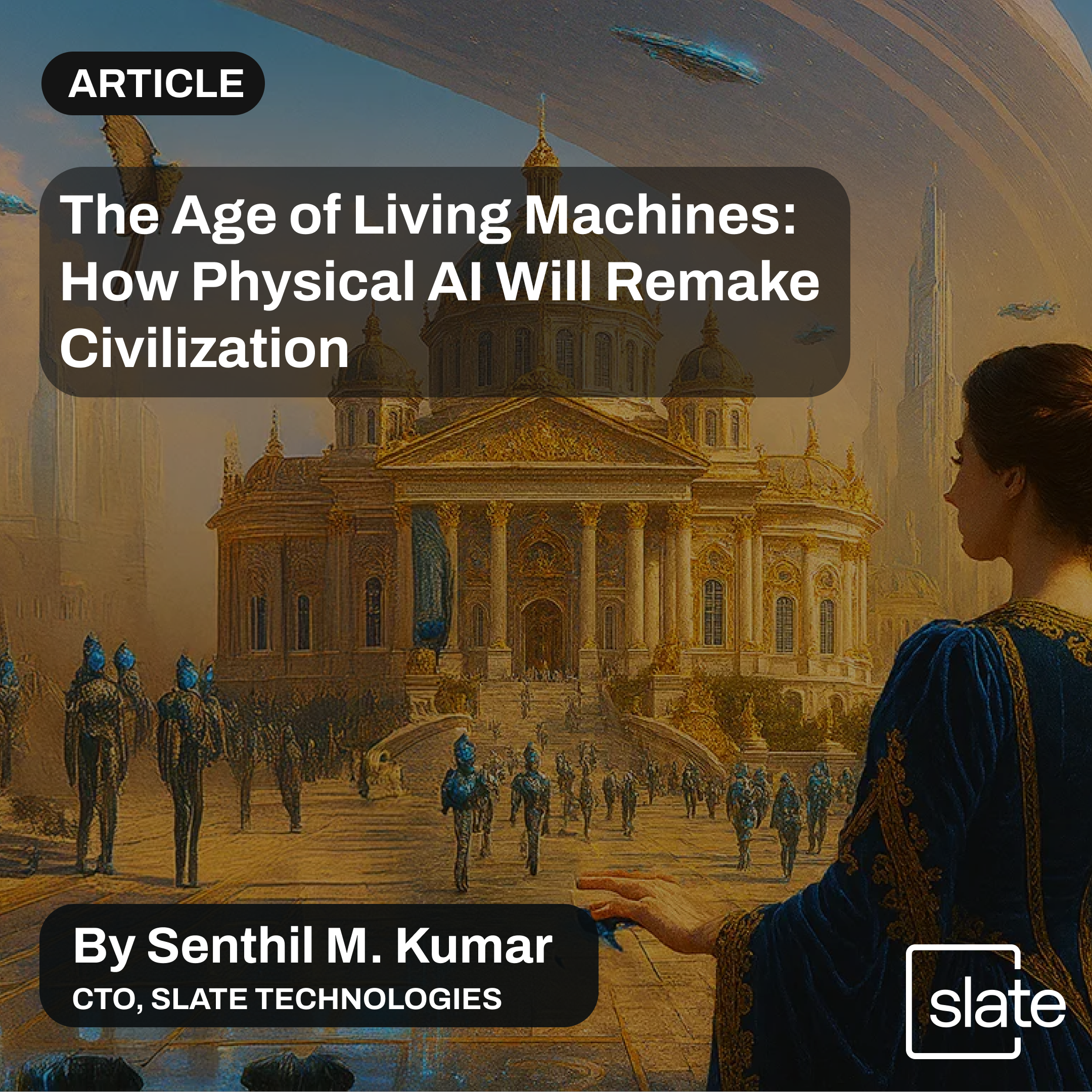
Originally published by Swiss Cognitive, The Age of Living Machines: How Physical AI Will Remake Civilization explores a pivotal shift in how artificial intelligence shows up in the world. In the article, Senthil M. Kumar, CTO of Slate Technologies, outlines why the next era of AI is not defined by automation alone, but by intelligence that can perceive, reason, and act in the physical world.
This shift marks the rise of what Senthil describes as Physical AI. These are systems that move beyond screens and software into machines, environments, and infrastructure. Rather than serving only as tools, they begin to operate as collaborators, shaping how industries function and how society evolves.
“Every age is defined by the tools it builds; this age is defined by the intelligence we set free to build with us.”
Senthil M. Kumar,
CTO, Slate Technologies
From Digital Intelligence to Embodied Action
For years, AI has excelled at analyzing information, generating language, and identifying patterns. Yet its influence largely stopped at insight. Physical AI closes the loop between thinking and doing. Intelligence becomes embodied, connected directly to sensors, machines, and real-world decision-making.
This transition enables systems that can respond dynamically to their surroundings, learn from human demonstration, and generalize across tasks. Advances in robotic foundation models, edge computing, and digital twin environments are making it possible for AI not only to understand the world, but to interact with it safely and in real time.
The result is a move away from narrow automation toward generalizable, embodied intelligence that operates alongside people.
Why Physical AI Changes the Stakes
As intelligence becomes physical, the consequences of failure change dramatically. Errors are no longer just incorrect predictions or flawed outputs. They can involve real-world harm, from medical mistakes to structural failures to economic disruption.
Because of this, Senthil emphasizes the importance of governance by design. Safety, transparency, and human values must be embedded directly into how these systems are built and deployed, rather than addressed after the fact. Trust becomes foundational when AI operates in environments where people live, work, and rely on physical outcomes.
Industry Impacts From Healthcare to Construction
The article highlights how Physical AI is already beginning to reshape critical sectors:
- In healthcare, embodied intelligence can connect diagnosis and intervention, enabling robotic caregivers, adaptive prosthetics, and real-time surgical assistance that works in partnership with clinicians.
- In commerce and finance, AI moves into logistics, fulfillment, and verification, creating what Senthil describes as an agentic economy where assets and contracts can act in the physical world.
- In architecture, engineering, and construction, Physical AI opens the door to living infrastructure. Robotic construction systems adapt to site conditions in real time, digital twins evolve as projects progress, and buildings themselves become responsive to environmental and human needs.
In construction specifically, this represents a shift from static plans to ongoing collaboration between humans, machines, and data. The built environment becomes something that senses, adapts, and improves over time.
An Agentic Civilization in the Making
At its core, the article frames Physical AI as the foundation of an agentic civilization. This is a future where intelligence does not simply assist humans but actively co-creates systems, environments, and institutions with them.
Senthil argues that future generations will not view this era as the triumph of automation, but as the moment intelligence became embodied and partnership replaced passivity. The choices made today, particularly around ethics, safety, and governance, will determine whether this collaboration strengthens trust and resilience or undermines it.
Looking Ahead
Physical AI is not a distant concept. Its early forms are already emerging across industries, unevenly but unmistakably. The question is no longer whether intelligence will move into the physical world, but how responsibly it will be designed and deployed.
As Senthil writes, every age is shaped by the tools it builds. This one will be defined by the intelligence we choose to build alongside us.
About the Author
Senthil M. Kumar is a globally recognised technology leader whose pioneering work in AI, Edge Computing, Blockchain, IIoT, and Robotics has helped shape the future of multiple industries worldwide, from healthcare and fintech to construction and autonomous systems. He currently serves as CTO of Slate Technologies and Senior Advisor to Celesta Capital, where he works alongside world leaders, Nobel laureates, and visionaries to advance deep technologies with real-world impact. Honoured by the Global Forums as a pioneer in AI and holder of numerous global patents, he also advises academia, startups, and the United Nations on the ethical and transformative role of artificial intelligence.